Written by Destiny · Tarot · 4 November 2026 · 6 min read
The Inverted Vector: How to Read Reversed Tarot Cards Grounded in Friction
An upside-down card is not an omen of doom or a negation of power. It is a precise diagnostic marker of internal focus, choked velocity, or displaced volume.
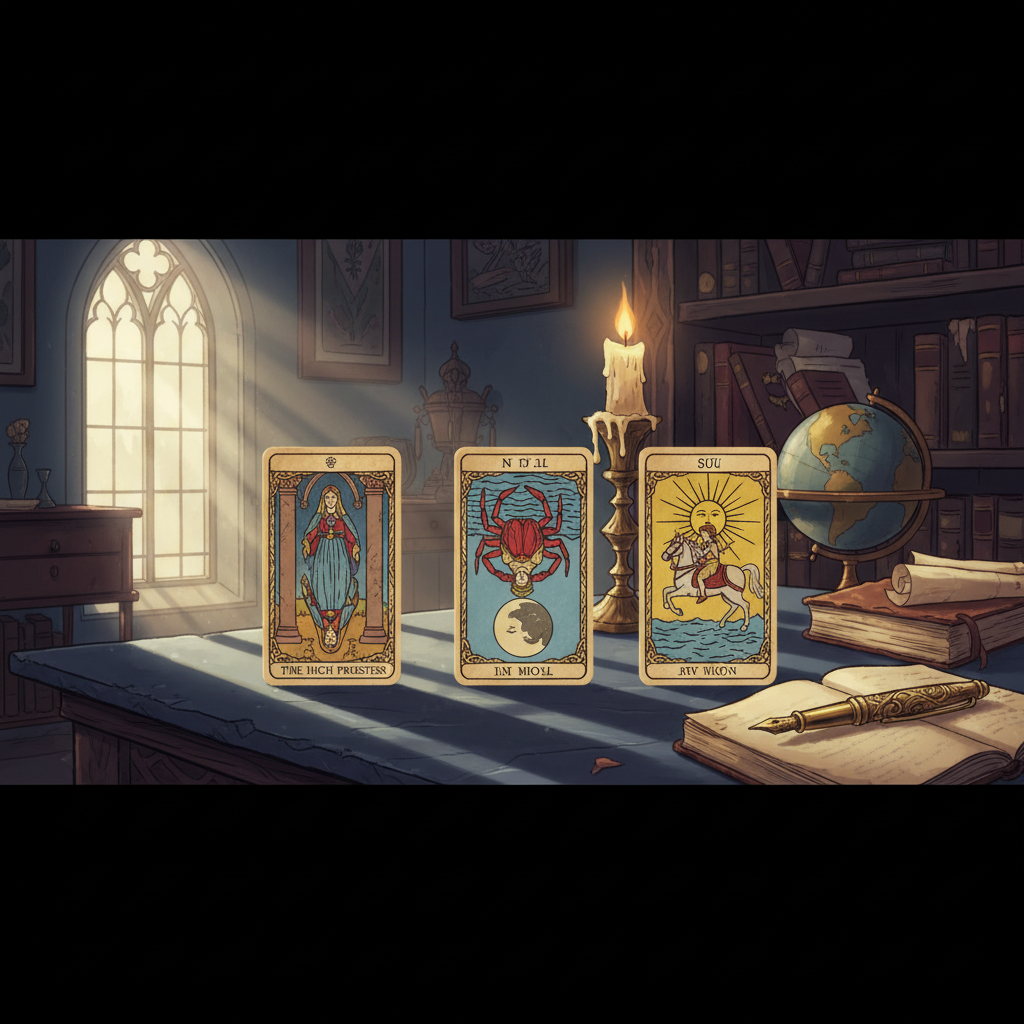
The physical moment of the draw is where the flinch happens. The deck opens, a card lands upside down on the cloth, and the eye registers the inverted figure—a king suspended on his crown, a cup spilling upward into open space—and the nervous system executes a quiet, familiar contraction. For many practitioners, an inverted card feels like a glitch in the engine or a sudden surcharge on the reading. The immediate impulse is superstitious: flip it right-side up, smooth the wrinkle, or brace for bad news.
This reaction comes from treating the tarot as a binary light switch: upright is operational, reversed is broken. But cards do not work like electrical circuits; they work like vectors. A reversed card is not a curse, a negation, or a sign that cosmic forces have turned hostile toward your project. It is simply a statement about direction, emphasis, and terrain. When you strip the moral panic from reversals, you double your working vocabulary without adding a single card to the deck.
The Binary Trap of Good and Evil
Most beginner reference books reduce reversals to a crude formula: take the upright meaning and invert it into its opposite. If the upright Sun represents vitality and success, the reversed Sun must mean depression and collapse. If the upright Ten of Cups represents familial harmony, the reversal must mean divorce. This method creates an unworkable reading environment. It turns the deck into a roulette wheel of blessings and catastrophes, leaving the practitioner at the mercy of mechanical chance.
More importantly, this binary model flattens the psychological precision of the cards. Human experience rarely operates in binary toggles. A long-term project does not instantly transform from brilliant success into total ruin simply because a piece of printed cardstock lands at a 180-degree offset. What actually happens in lived reality is far more nuanced: momentum slows, internal doubt surfaces, or an external system resists input. Reversals are the quiet machinery of friction, not the blunt instrument of doom.
Reversals as Internalized Currents
The most reliable framework for reading a reversed card is the distinction between external expression and internal processing. An upright card usually describes an event, an archetype, or an environmental pressure operating visibly in the world. A reversed card often indicates that the exact same archetype is operating beneath the skin—quietly, privately, or unexpressed.
Consider the Three of Swords. Upright, it traditionally represents heartbreak, clear-cut grief, or a sharp, painful realization delivered by an external event. It is a storm you walk through in public view. Inverted, the grief does not magically turn into joy. Instead, the sharp edge turns inward. It points to silent rumination, unexpressed sorrow, or the slow, unglamorous process of pulling out an old spike that was buried months ago. The core material—grief and clarity—remains identical, but its theater of operation shifts from the room to the mind.
Similarly, the Queen of Wands upright is a figure of visible charisma, commanding public attention and directing social energy with ease. Reversed, she does not become a coward. She becomes a private powerhouse: someone cultivating deep personal conviction, working on a project behind closed doors, or rebuilding her self-worth away from the validation of an audience. The energy is fully intact; it simply lacks an external loudspeaker.
The Mechanics of Friction and Delay
A second primary function of the reversal is to register resistance within a system. In physics, when an engine works harder to produce less forward movement, we look for drag, poor lubrication, or mechanical misalignment. In a spread, a reversed card functions as a diagnostic marker for this exact kind of terrain friction.
Take the Eight of Wands. Upright, it depicts swift flight, rapid communication, and vectors aligning toward a goal without impediment. In reverse, the arrows do not explode; they encounter air resistance. Messages hit spam folders, bureaucratic sign-offs take three weeks instead of three hours, or your own internal focus is scattered across too many competing priorities. The destination has not vanished, but the speed of transmission has dropped.
Reading reversals as friction allows you to make practical adjustments rather than panicking. If the Knight of Pentacles lands upside down in a query about a operational launch, it is not a signal to abandon the venture. It is an alert that your mechanics are bogged down—perhaps in overly complex logistics or unnecessary perfectionism. The card is not telling you to stop; it is telling you to inspect the gears.
Excess, Deficiency, and Choked Channels
Cards can also drift off course by degree rather than by direction. Every archetype has an optimal operating range. When a card appears reversed, it can indicate that the quality it represents is either starved of expression or pushed to a destructive extreme.
The Four of Pentacles is a clear case study in volume control. Upright, it represents reasonable boundaries, financial prudence, and foundational stability. Reversed, it frequently swings toward one of two extremes: total miserliness and paranoia on one end, or a reckless bleeding of resources and complete lack of structure on the other. The upside-down orientation signals that the healthy equilibrium of security has been lost.
When you view a reversal through the lens of volume, your task as a reader becomes diagnostic rather than predictive. You are no longer asking, "What bad thing will happen to me?" You are asking, "Where am I over-correcting? Where am I withholding?" This shift restores agency. It moves you out of a passive posture of waiting for impact and into an active posture of calibration.
Establishing Your Syntax Before the Shuffle
The single biggest source of anxiety around reversed cards is interpretive ambiguity. If a reversal can mean internal energy, mechanical friction, or excessive volume, how do you know which reading to apply in the moment? The answer lies in establishing a strict interpretive agreement with your deck before you cut the cards.
Intuitive practice decays into anxiety when the reader decides the rules mid-stream. If you pull a reversed card while feeling vulnerable, an open framework allows your subconscious fear to select the most catastrophic reading available. To prevent this, define your syntax upfront. Many experienced readers decide that reversals in position one will always indicate internal states, while reversals in position three indicate external delays. Others use reversals strictly as markers of friction.
Consistency builds clean signal. It matters less which specific system you adopt—whether you treat upside-down cards as internalized currents, developmental delays, or shadowed potential—so long as your mind relies on a stable grammar. When the rules of translation are fixed beforehand, an inverted card loses its power to startle and retains only its power to inform.
A tarot deck is a diagnostic mirror composed of seventy-eight panels. Turning twenty-six of those panels upside down does not crack the glass; it simply changes the angle of reflection. When you stop fearing the inverted card, you stop looking for omens and start reading real dynamics.
This Week's Practice: Select three cards you know intimately—such as The Emperor, the Five of Cups, and the Eight of Pentacles. Lay them upright on your workspace. In your working notebook, write down three distinct translations for each card. First, record its standard external manifestation (Upright). Second, write how that exact energy looks when turned purely inward (Internalized). Third, write how that energy looks when it hits operational friction or extreme volume (Blocked/Excess). Do not consult a guide manual. Rely entirely on your observation of human behavior. By building these explicit translations beforehand, you strip the dread from the flip and replace it with precise diagnostic clarity.