Written by Destiny · Practice · 2 October 2026 · 6 min read
The Cold Altar: How to Return to a Practice You Dropped
A practical guide to clearing away the shame of an interrupted ritual, discarding the debt mindset, and making a quiet, clean re-entry.

There is a specific quiet that gathers around a neglected practice. The notebook stays closed on the shelf; the deck sits in its cloth wrap at the back of a drawer; the transit tracking app remains unvisited for three months while life expands, collapses, or simply gets busy. When you finally look toward that corner of your room or your routine, what you feel is rarely curiosity. More often, it is a low-grade, persistent shame—the sense that by stepping away, you broke a contract, missed important signals, or failed a test of personal discipline.
This shame transforms a tool of self-inquiry into a moral tribunal. The altar—whether physical or metaphorical—becomes cold, not because the magic vanished, but because you loaded the space with unspoken debt. You begin to feel that before you can draw another card or sit for ten minutes in silence, you must first account for your absence. You feel you owe the practice an apology, or worse, a massive effort of reconstruction to bridge the gap between who you were when you stopped and who you are now.
The Trap of Retrospective Debt
The most common mistake people make when returning to a practice after a lapse is attempting to audit the dark period. They look back at the three, six, or twelve months of unrecorded transits or unpulled cards and feel an urgent need to summarize what happened. They want to backdate journal entries, read retroactively about the Saturn transit they ignored during their job transition, or perform a sprawling spread to explain why they dropped out in the first place.
This is a form of spiritual accounting, and it is almost entirely counterproductive. A practice is not an archive; it is an instrument for engaging with the present moment. When you try to clear the backlog, you turn a living discipline into administrative work. You treat your intuitive life like an inbox that accumulated unread mail while you were out of the office.
If you dropped your practice during a period of crisis, burnout, or intense outward activity, that interruption was likely a necessary conservation of energy. In the Rider–Waite–Smith system, the Four of Swords shows a knight lying in repose inside a church, hands folded in prayer, a sword lying beneath him. It is a card of deliberate, unglamorous withdrawal. The sanctuary is not a place where work is performed; it is a place where work is suspended so the nervous system can reset. When your practice fell away, it was often because your mind reached its limit for analysis. Forcing yourself to retroactively analyze the period of rest defeats the purpose of the rest itself.
The Fantasy of the Unbroken Chain
Modern habit culture has conditioned us to revere the streak. We are taught that the value of an action lies in its unbroken repetition—that thirty consecutive days of meditative sitting or daily card pulls is inherently superior to twenty days spread across two months. This linear expectation is fundamentally at odds with how human attention and seasonal lives actually operate.
Astrology reminds us constantly that nature does not operate in unbroken straight lines. Planets station retrograde; cycles end, dissolve into dark moon phases, and slowly re-emerge. No one demands that the moon stay full for thirty days to prove its efficacy. Yet practitioners routinely treat a three-week gap in their notebook as a catastrophic structural failure rather than a natural ebb in the tide of their attention.
When you believe that a practice only works if it is continuous, every break becomes a total reset back to zero. This creates a brittle dynamic: the moment life intrudes and breaks the chain, the entire structure feels ruined, so you abandon it completely for months. To build a durable relationship with any reflective work, you must abandon the fantasy of the unbroken chain. A mature practice is not a fragile piece of glassware that shatters upon impact; it is a trail carved into a landscape. If you do not walk it for a month, the grass grows over it slightly, but the ground beneath remains firm. You do not need to build a new road; you simply step back onto the path.
Lowering the Threshold of Re-Entry
When people decide to start over, they often plan a grand gesture of re-commitment. They schedule an hour-long session, clean the entire room, light three different herbs, and prepare a twelve-card wheel spread to map out the next year. This high operational bar is often just another obstacle disguised as devotion. The sheer effort required to perform the homecoming ritual becomes a reason to put it off until next Sunday, then next month.
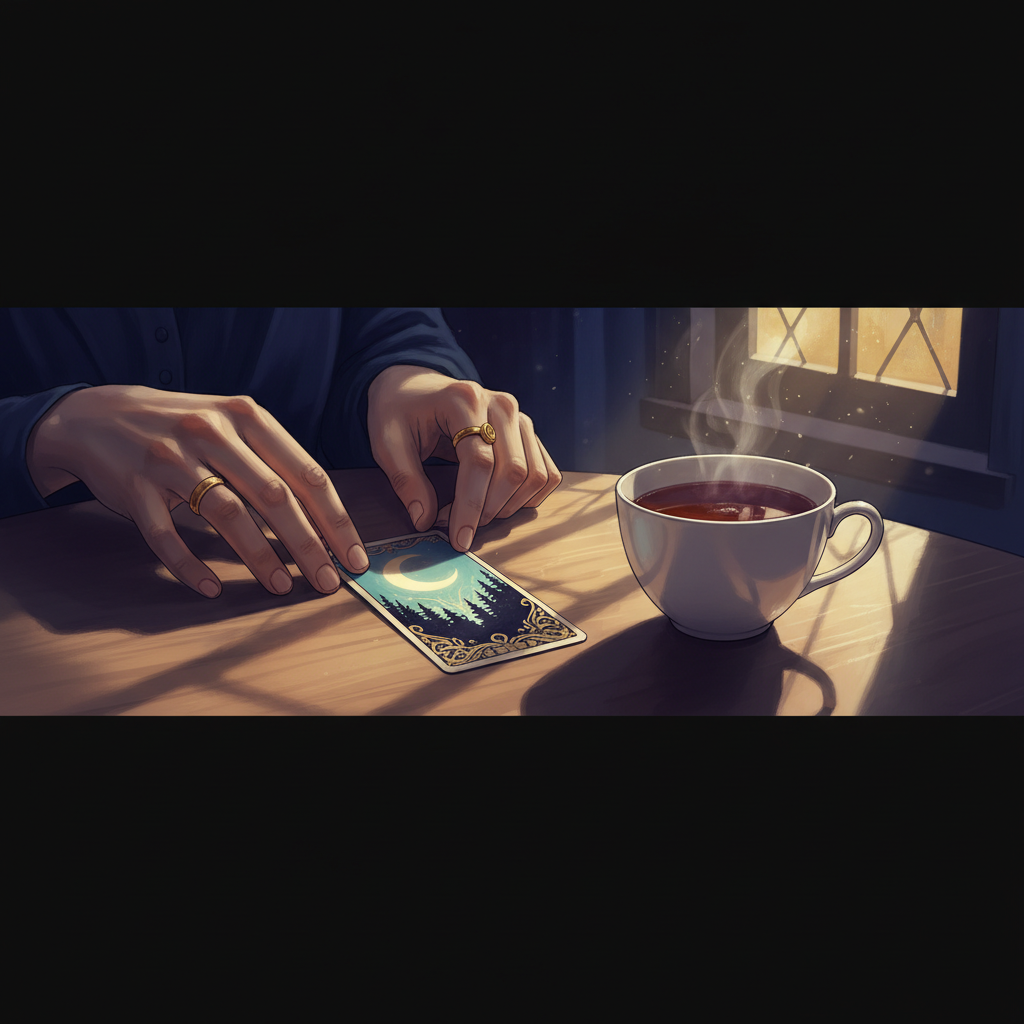
The secret to returning to a dropped practice is to make the re-entry absurdly, radically simple. You must lower the threshold of engagement so far that your defensive instincts have nothing to fight against.
If you dropped your tarot practice, do not perform a multi-card diagnostic spread on your relationship with the cards. Pull one card. Place it on the table. Look at it for sixty seconds while your kettle boils. Do not write a thesis on it; do not cross-reference four guidebooks. Note the primary emotion or image that strikes you, put the card away, and go about your day. If you dropped your journal, do not try to summarize the winter you missed. Write one clear sentence about how your body feels right now, in this room, at this hour.
This micro-engagement breaks the seal of avoidance without triggering the exhaustion that caused the lapse in the first place. It proves to your subconscious that the altar is safe, that it does not demand a sacrifice of time you do not currently have.
Rewriting the Altar's Contract
A practice must serve the person doing it; the person does not serve the practice. If your intuitive work feels like an exacting landlord demanding rent, the contract is broken. You have slipped into a performance model, where you view your cards, your charts, or your cushion as tools for proving how self-aware, disciplined, or spiritual you are.
When you return after a long absence, take the opportunity to rewrite the terms. Ask yourself what you actually need from this work right now. Six months ago, you might have needed detailed structural tracking of your transits to navigate a career shift. Today, you might simply need five minutes of quiet visual contemplation before your household wakes up. The tools do not care how you use them. The deck does not feel insulted if it sits in a silk bag for half a year, nor does it hold a grudge when you open it again.
The Cards of the Major Arcana—from the unburdened step of The Fool to the quiet resolution of The World—describe an ongoing process of orientation, not a test you pass or fail. The Fool begins with nothing but a small bundle and a willingness to take a step without knowing the entire terrain. Returning to a practice requires that exact quality of foolishness: the willingness to begin again without prestige, without a record of recent success, and without a dramatic explanation for why you left.
The Work of the Week
This week, locate the physical object tied to your dropped practice—your deck, your journal, your cushion, or your transit ephemera. Bring it out of storage and put it somewhere visible, but do not promise to use it every day.
Instead, choose a single, non-negotiable moment to perform a thirty-second re-entry. If it is a deck, shuffle once, pull one card, place it face up on your desk, and walk away. Do not look up the meaning in a book. Do not analyze what it portends for your finances or your relationships. Simply notice one detail in the artwork—the color of a robe, the position of a hand, the tilt of a figure's head—and let that be the entire practice for the day.
You are not clearing a debt. You are not catching up. You are simply letting your hands remember the weight of the tool.