Written by Destiny · Decisions · 7 October 2026 · 6 min read
The Seat of Judgment: How to Preserve Your Capacity for Hard Choices
Good judgment is not a permanent character trait, but a metabolic resource easily squandered on daily friction. Here is how to build structural boundaries around your mind before exhaustion makes your choices for you.
By mid-afternoon, most people believe they are still evaluating options with the same intellect they brought to breakfast. This is a common and costly delusion. Judgment is not an intangible, infinite faculty that operates detached from physical reality. It is an energy-intensive process, deeply tied to the body, subject to friction, and subject to rapid depletion. When you ask yourself to make dozens of trivial choices before lunch—what to answer, what to wear, which route to take, how to phrase a minor correction—you are spending the exact same mental capital required to navigate a career shift, a relationship boundary, or a complex financial commitment.
The result of this unmanaged spending is rarely a dramatic collapse. Instead, it manifests as a quiet erosion. You begin choosing whatever option presents the path of least immediate resistance, or conversely, you freeze entirely, overwhelmed by options that should be easy to sort. In the language of tarot, you slip from the poised, upright clarity of the King of Swords into the defensive, blindfolded stagnation of the Two of Swords. Protecting your capacity to make clear choices requires recognizing that discernment is a finite resource, and treating your mind not as an open highway, but as an enclosed sanctuary.
The High Cost of Small Choices
In classical astrology, Mercury governs the machinery of the mind: the collecting of data, the routing of messages, the categorization of details, and the immediate verbal response. Mercury is quick, adaptable, and naturally curious. But Mercury left to its own devices without structural governance becomes frantic. It wants to inspect every pebble on the road. When you allow your daily environment to flood you with unstructured requests for attention, Mercury burns through your reserves of focus on matters that have zero long-term impact.
The Suit of Swords in the tarot visualizes this mental landscape. Swords represent the intellect—a tool designed for cutting, separating, and defining truth from noise. Yet a blade used to cut brush all morning will not hold a razor edge when you need to execute a clean, precise surgical incision in the afternoon. Every micro-choice requires a small cut. When you reach the end of the day and find yourself unable to decide what to cook for dinner, or reacting with uncharacteristic irritation to an unexpected question, it is not because you lack character. It is simply that the blade has been dulled by a thousand unnecessary impacts.
The first step in protecting your judgment is accepting that your mind cannot distinguish between the metabolic cost of a critical life decision and the metabolic cost of a trivial operational choice. Both draw from the same well. If you leave that well open to every passing demand, you will inevitably find it dry when you need it most.
The Two of Swords and the Myth of Willpower
In the Pamela Colman Smith illustration of the Two of Swords, a figure sits on a stone bench wearing a gray robe and a tight blindfold. In her hands, she holds two massive crossed swords across her chest, perfectly balanced but entirely static. Behind her lies a body of water dotted with jagged rocks. Traditionally, this card is read as stalemate or avoidance—a refusal to choose. But viewed through the lens of cognitive preservation, it reveals something more specific: the posture of a mind that has reached total processing saturation.
The blindfold in the Two of Swords is not necessarily a symbol of ignorance; it is often a desperate self-defense mechanism. When visual and cognitive input becomes too vast, the mind shuts down the intake valves. It crosses its arms and refuses to move because it lacks the internal clarity required to weigh the options safely. The jagged rocks in the water represent the hazards of making a move while in this state. If you force a decision when your system is in Two of Swords exhaustion, you will almost certainly choose out of fear, impulse, or a desperate desire to simply have the tension end.
We tend to rely on willpower to drag ourselves out of this paralysis. We tell ourselves to focus harder, to sit down and figure it out, to push through the fog. But willpower is merely another function of the same exhausted mental system. Trying to solve decision fatigue through sheer force of will is like trying to put out a fire by throwing dry wood on it. What is needed is not more effort, but structural protection.
Saturnian Containers for Daily Energy
If Mercury represents the fast-moving intake of data, Saturn represents the container that keeps that data from scattering into chaos. Saturn is the principle of boundaries, rules, schedules, and structural limits. Without Saturn, mental energy dissipates. To preserve your judgment, you must establish hard, non-negotiable Saturnian rules in your daily life that eliminate low-stakes decisions before they ever reach your desk.

Consider the routine of the monastic, the craftsman, or the seasoned professional. They do not wake up each morning and negotiate with themselves about when to start work, what tools to arrange, or how to handle basic maintenance. Those choices were settled weeks or years ago by rule. By converting recurring, low-value choices into automatic habits or strict protocols, you protect your active processing power for moments that actually demand original thought.
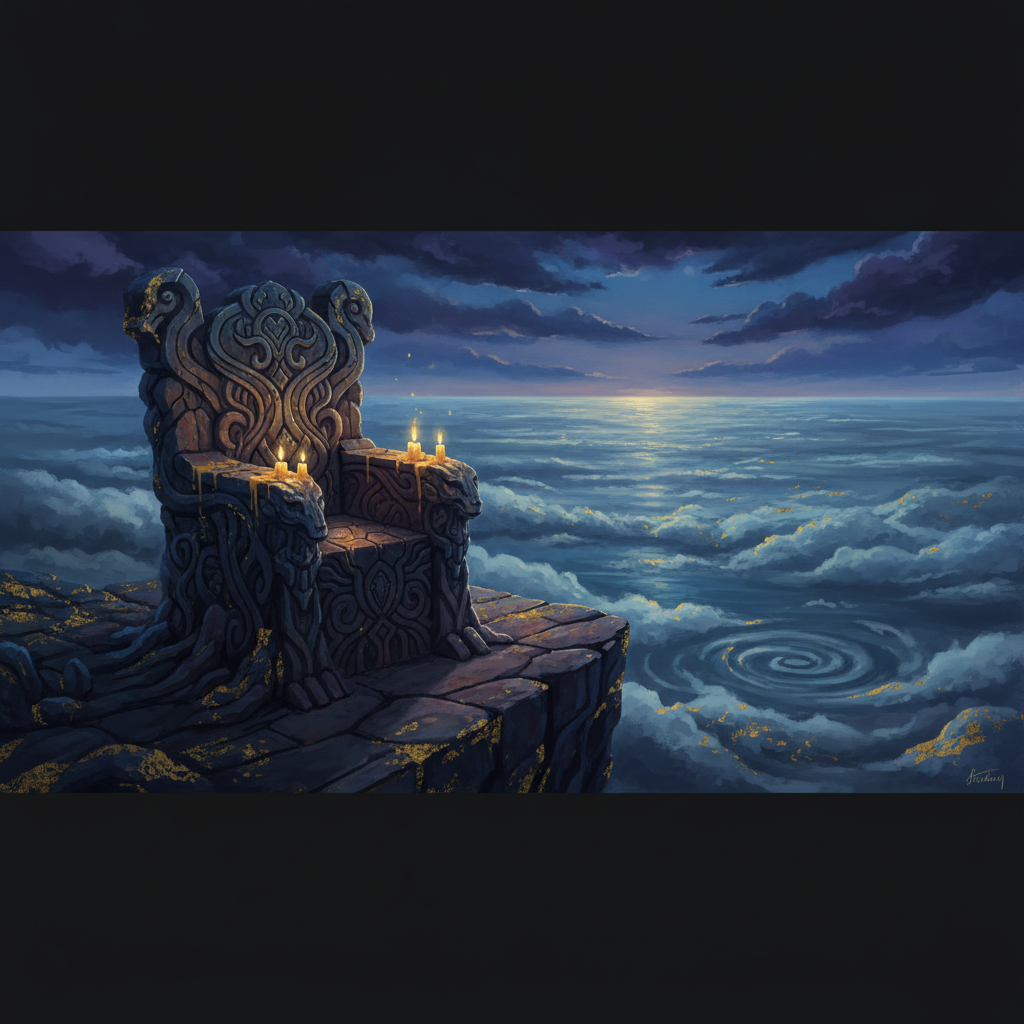
Establishing these containers requires an honest audit of where your attention leaks. If you spend fifteen minutes every morning deciding which task to begin first, you have already wasted high-grade focus on an administrative problem. A Saturnian boundary demands that tomorrow’s priorities are written down before you step away from work today. When the rule makes the choice, your intellect remains rested, seated on its throne, ready to be called upon for work that genuinely requires discernment.
The Sanctuary of the Four of Swords
There is a crucial difference between turning off your mind out of exhaustion and deliberately stepping back to clear the workspace. The Four of Swords depicts a knight lying resting on a tomb inside a quiet sanctuary. Three swords hang above him on the wall; a fourth lies beneath his body. This is not the passive collapse of the defeated; it is the calculated, strategic retreat of the warrior who knows that rest is an active component of effective action.
The three swords hanging on the wall represent the problems that remain unresolved, but which have been temporarily suspended. They are held in place by boundary lines, not abandoned. The fourth sword, beneath the figure, is the fundamental core of personal agency—kept close, but currently resting. This card reminds us that deep evaluation cannot occur in the middle of the noise. High-stakes judgment requires deliberate periods of zero intake.
Protecting your judgment means instituting mandatory buffer zones between receiving complex information and delivering a final response. When faced with a heavy decision, the impulse of the fatigued mind is to settle it immediately just to relieve the pressure of uncertainty. The Four of Swords counsels the opposite: enforce a cooling period. Lay the problem on the wall, step away from the intake of new opinions, and allow the background processing of your mind to settle the mud until the water runs clear.
The Practice: The Decision Audit and Standing Rule
To move this principle out of theory and into your week, you must construct a functional barrier around one specific point of daily cognitive leakage. Good judgment is cultivated through deliberate engineering, not hope.
This week, perform a brief audit of your daily routine to identify one recurring micro-choice that consistently taxes your morning or mid-afternoon attention. It might be deciding what to cook after a long shift, deliberating over how to answer routine emails, or trying to schedule workout times on a day-by-day basis. Pick one single point of friction.
Once identified, draft a single, non-negotiable standing rule for that issue that will remain in effect for the next seven days. Remove your option to choose. If it is food, set a fixed three-day rotation menu. If it is communication, set a strict, unyielding hour of the day for correspondence and refuse to open your inbox outside that window. If a new, major decision presents itself during the week, institute a mandatory 24-hour Four of Swords pause before delivering your answer.
Observe how much mental space opens up when you stop asking your mind to deliberate on routine administration. You are restoring the blade to its proper sheath, ensuring that when a real choice demands your intervention, you can bring an unclouded mind to the seat of judgment.