Written by Destiny · Practice · 9 October 2026 · 5 min read
The Seasonal Inventory: How to Audit and Realign Your Daily Practice
A practice that never changes eventually rots into routine. Here is a practical framework for clearing away dead habits every three months.

The subtle danger of a healthy routine is its tendency to become a monument. You establish a morning card draw, a weekly journal prompt, or an evening reflection log because it served a specific season of crisis, career pivot, or inner restlessness. Six months later, the crisis has evaporated, your life has shifted its center of gravity, but you are still sitting at the same table drawing three cards for a day that no longer demands that kind of triage. The practice continues out of sheer muscle memory, but the voltage drops to zero.
A reflective practice is not a museum piece to be preserved against time; it is a crop that requires clearing, pruning, and fallow periods. To keep your work alive—whether that means tarot, astrological observation, decision logging, or contemplative discipline—you must periodically step back and audit what it is currently producing. The natural boundary for this review is seasonal. At each solstice, equinox, or simply every ninety days, you need a cold-eyed framework to examine what to keep, what to prune, and what to redesign.
The Trap of Eternal Maintenance Mode
When a practice stagnates, it usually fails in one of two ways: it becomes a compulsive chore, or it becomes an aesthetic retreat. In the first case, you record entries and pull cards out of a vague guilt, treating your altar or desk like a manager treating a daily punch card. In the second case, the practice becomes a cozy sanctuary detached from your actual choices—a place where you light incense and admire your notebooks while your real work, money, and relationships drift without oversight.
Both failures stem from treating practice as a static obligation rather than a dynamic tool. When you first picked up a deck or opened a decision log, you were trying to solve a problem of perception: you wanted to see clearly, feel deeply, or choose wisely. But human life moves in quarters, marked by changing daylight, project lifecycles, and shifting emotional weather. A method that gave you immense clarity during a chaotic winter relocation will only suffocate you during a summer dedicated to focused execution.
The Four-Element Audit Framework
To conduct an honest seasonal inventory, you do not need complex ritual software. You need four specific diagnostic questions, derived from the foundational elements of classical Western traditions and the four suits of the Minor Arcana. Set aside an hour at the end of every quarter to run your practice through this filter.
First, assess **Wands (Fire & Vitality)**: *Does this habit currently generate energy, or drain it?* If opening your journal feels like dragging a heavy stone uphill before your morning coffee, the format is dead. Fire requires fuel and air; if a practice feels suffocating, you have built a furnace with no draft.
Second, assess **Cups (Water & Relational Truth)**: *Are you recording what you actually feel, or what you think you should feel?* Look back over your last month of notes. If the tone is uniform, polished, or performatively wise, you have drifted into self-editing. A useful practice must have room for raw angst, petty frustration, and unvarnished grief.
Third, assess **Swords (Air & Strategic Mechanics)**: *Is the system friction-free and intellectually crisp?* If your morning routine takes forty-five minutes because you are shuffling three different decks, checking four transit apps, and filling out five journal sections, your mechanics are bloated. Air demands simplicity and swift execution.
Fourth, assess **Pentacles (Earth & Tangible Output)**: *What visible difference has this practice made in your material life over the last ninety days?* Look at your calendar, your finances, your health habits, and your hard decisions. If your practice operates entirely in the sky of abstract insight and leaves no footprint on the ground, it is an idle distraction.
Pruning the Dead Wood
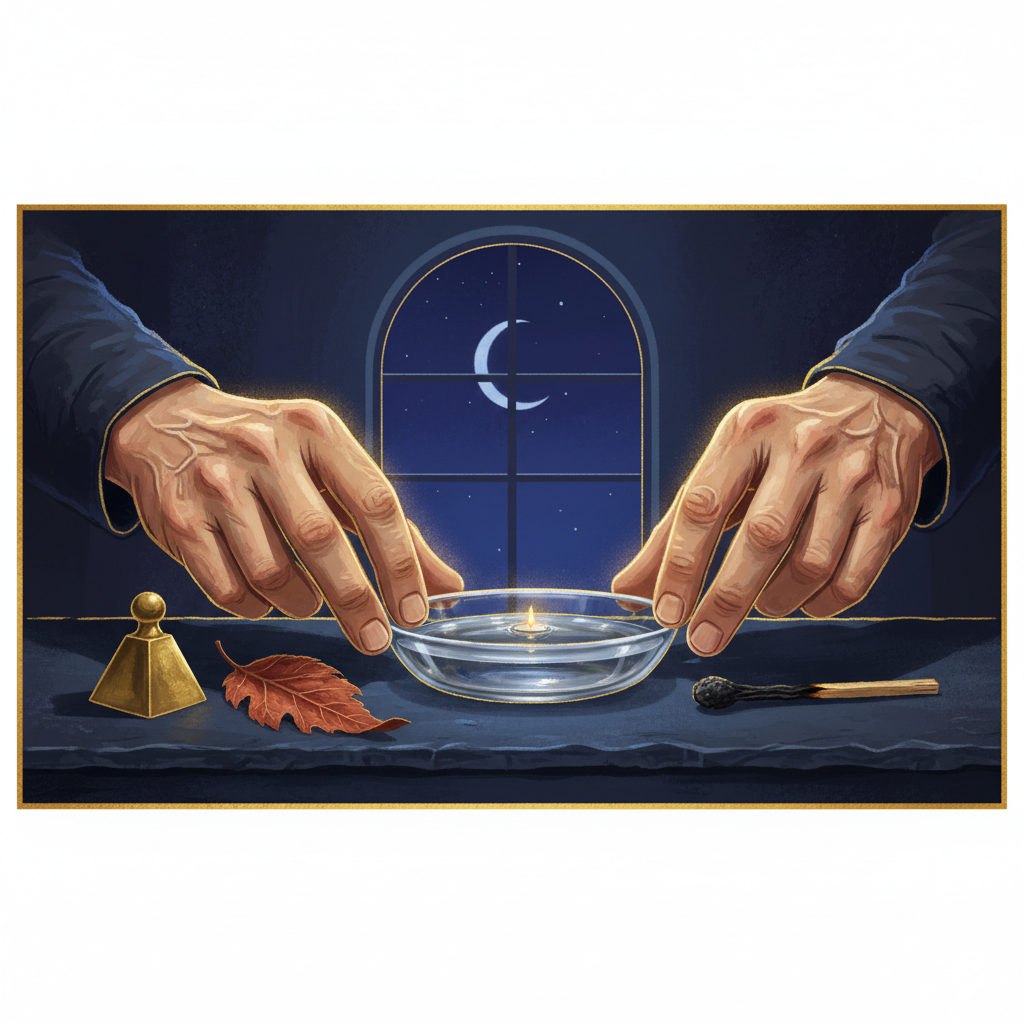
The hardest part of a seasonal audit is stopping a habit that used to work. Human beings are susceptible to the sunk-cost fallacy, especially when it comes to self-improvement. If you spent months learning a complex ten-card spread or building an elaborate digital transit tracker, giving it up feels like a defeat.
In the Rider–Waite–Smith imagery, the Eight of Cups captures this exact moment. A figure turns their back on eight carefully stacked chalices to walk toward higher ground. Those cups are not broken; they were built with real skill and filled with genuine effort. But the water in them has gone stagnant. Walking away is not a failure of discipline; it is an act of maturity.
If your ninety-day review reveals that your daily single-card pull has turned into a meaningless reflex, eliminate it. If your detailed transit diary feels like an administrative burden, replace it with a simple weekly note on where the Sun is transiting. Pruning is not destruction; it is how you redirect vitality to the branches that are actually capable of bearing fruit this season.
Designing the Next Ninety Days
Once you have cleared out the dead routines, design a hyper-specific protocol tailored to the upcoming season's practical demands. Do not plan for the rest of your life; plan strictly for the next three months.
If your upcoming quarter involves high-stakes negotiation or heavy workloads, your practice should lean heavily into Swords and Pentacles: short, daily decision logs, risk assessments, and practical boundaries. If your upcoming quarter is meant for rest, recovery, or creative exploration, your practice should shift toward Wands and Cups: unprompted freewriting, intuitive card readings focused on desires rather than mechanics, and open-ended observations of nature.
Write your seasonal protocol down on an index card and tape it to the front of your notebook. Specify the exact time, the exact tools, and the exact length. For example: *Autumn Protocol: October 1 through December 31. Five minutes every morning. One card drawn for the primary tension of the day. One line written in the log. No transit checking until Sunday afternoon.* Setting strict parameters prevents ritual drift.
The Work for This Week
Before this week ends, conduct your seasonal audit. Do not wait for an equinox or a new year if your practice is already faltering; any Sunday evening will do.
Clear your workspace entirely. Place your journals, decks, and logs on the table. Take a blank sheet of paper, divide it into four quadrants labeled *Energy (Wands)*, *Truth (Cups)*, *Clarity (Swords)*, and *Results (Pentacles)*, and answer the four audit questions with brutal honesty.
Identify one element of your current routine that has lost its voltage, and formally discard it for the next ninety days. Then, write your simple, streamlined seasonal protocol on a card, place it in your notebook, and commit to testing it without alteration until the next turn of the season.