Written by Destiny · Tarot · 11 November 2026 · 6 min read
The Dialectic on the Table: How to Read Contradictory Tarot Spreads
When cards in a spread seem to outright refute one another, the reading hasn't broken. Here is how to navigate paradox, friction, and competing truths across your layout.
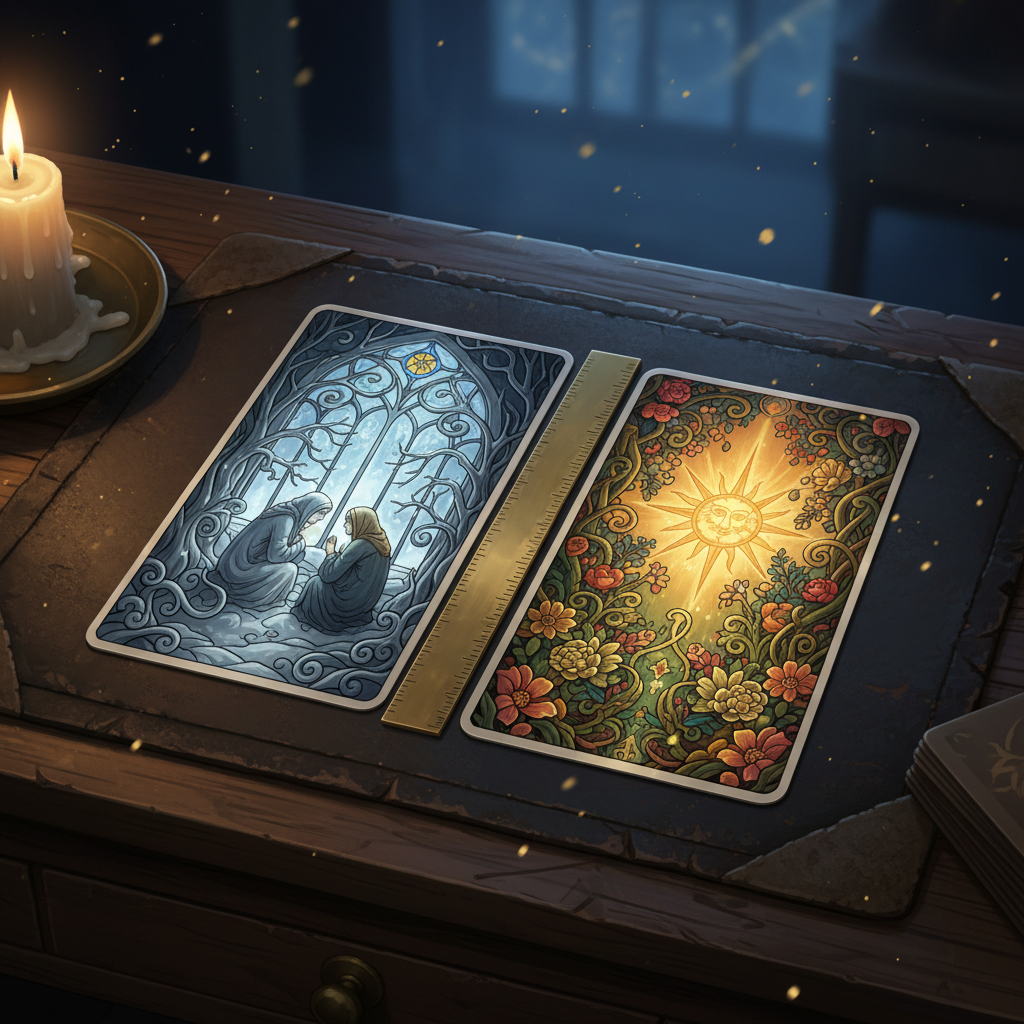
Every reader eventually encounters the moment of mechanical friction: you lay out a three-card spread for clarity on a professional crossroad, and you draw the Ten of Cups alongside the Five of Pentacles. Or perhaps you ask about an internal block, and the Three of Swords sits comfortably next to The Sun. The instinct in that moment is almost always technical doubt. You assume you shuffled poorly, that your focus slipped, or that the deck is offering a nonsensical garble of static. The immediate impulse is to scoop the cards back up, clear the deck, and draw again until the story aligns into a single, seamless vector.
Resisting that urge to reshuffle is the precise point where amateur cartomancy turns into a serious analytical practice. Human experience is rarely clean, singular, or internally consistent; we routinely hold immense gratitude alongside bone-deep exhaustion, or experience material security while suffering acute emotional isolation. A tarot spread is not a smoothed-out narrative curve or a fortune to be decoded. It is a structural cross-section of a dynamic field. When two cards appear to violently contradict each other, the deck is not broken. It is pointing directly at the central friction of your situation.
The Myth of the Monolithic Narrative
The desire for cards to agree stems from a misunderstanding of how symbolic systems function. Beginner readers often search for a monolithic narrative—a simple story where every card acts as a synonym for the card beside it. If the first card is challenging, they expect the second and third to mirror that difficulty; if the first card is luminous, they expect a sequence of gentle validation. But if a deck only confirmed a single emotional state across an entire layout, it would be useless for complex decision-making.
In traditional Rider–Waite–Smith imagery, cards represent distinct forces, temperaments, and structural conditions, not fixed fates. The Five of Pentacles—depicting two figures walking through the snow outside a lit stained-glass window—is an architecture of exclusion and perceived scarcity. The Ten of Cups depicts emotional saturation and communal alignment. When both land in the same reading, they are not cancelling each other out like positive and negative numbers on a ledger. They are mapping two coexisting realities. You can be standing in an environment of genuine abundance while operating from an internal engine of cold, habitual scarcity.
The Positional Audit: Context Over Content
Before attempting to synthesize two paradoxical cards, you must audit the architecture of the spread itself. Contradiction is often an artifact of poor spatial discipline. If you drop three cards onto a table without clear, pre-defined positional meanings, any opposition between them feels like an error. But if Card A occupies the position of 'Current Environment' and Card B occupies 'Internal Anxiety,' the friction vanishes. A spread with clear boundaries contextualizes conflict immediately.
Consider an instance where positional parameters are clear, yet the conflict remains sharp—such as a card representing your goal directly opposing the card representing your current action. If your goal is represented by the Four of Swords (rest, retreat, deliberate silence) but your action card is the Eight of Wands (rapid communication, high-velocity movement), the spread is not delivering a mixed message. It is highlighting a mechanical misalignment. You are attempting to arrive at stillness by sprinting. The tension between the cards is the exact diagnostic data you pulled the spread to find.
Elemental Dignities and Mechanical Friction
Beyond positional mechanics, cards communicate through their elemental drenching: Wands (Fire), Cups (Water), Swords (Air), and Pentacles (Earth). In classical cartomancy, elemental dignities dictate how cards modify one another. Fire and Water are naturally antithetical; Fire boils Water into steam, while Water extinguishes Fire. Air and Earth represent a similar tension; Air blows across Earth creating dust, while Earth stifles the movement of Air.
When you see elemental antipathy—such as the King of Cups placed next to the King of Swords—you are viewing two incompatible modes of authority. The King of Cups governs through relational empathy and emotional intuition; the King of Swords governs through objective distance, cold logic, and linguistic precision. If these two cards appear side by side in a decision-making spread, the reading is not giving you a bad forecast. It is signaling a boundary conflict between how you feel about a situation and how you must evaluate it logically. The friction is the message: you cannot solve a King of Swords problem with a King of Cups strategy without generating structural heat.
Temporal Offset: The Lag Between Planes
Another frequent cause of apparent contradiction is temporal offset—the reality that different parts of our lives move at entirely different speeds. Material realities (Pentacles) tend to change slowly, like heavy timber. Mental shifts (Swords) occur in a split second. Emotional processing (Cups) lags behind mental understanding, while raw will or inspiration (Wands) surges and dissipates unpredictably.
When a spread contains contradictory cards, check whether you are observing a temporal lag between planes. If you draw the Nine of Swords (acute mental panic and catastrophic thinking) alongside the Four of Wands (established stability and celebration), you are looking at a classic temporal discrepancy. The external reality—the Four of Wands—is solid and secure. The internal reality—the Nine of Swords—is reacting to an obsolete threat or an imagined future. The cards contradict each other because your mind and your circumstances are living in two different time zones. Recognizing this offset prevents you from reacting to mental distress as if it were an objective material crisis.
The Dialectic Method: Thesis, Antithesis, Tension
To read a contradictory spread effectively, apply a basic dialectical framework. Treat Card A as your Thesis (the primary force at play) and Card B as your Antithesis (the opposing force). Do not force them into an immediate, comfortable middle ground, and do not average their meanings. If you draw the High Priestess (reception, stillness, secrets) and the Eight of Wands (action, overt movement, speed), the answer is not 'move at a medium pace.' The answer lies in holding both extremes simultaneously until their relationship reveals itself.
Ask yourself: How does the Thesis generate the Antithesis? In this pairing, the deep internal quiet of the High Priestess might be the necessary prerequisite for the explosive, accurate movement of the Eight of Wands. Or, conversely, the chaotic velocity of the Eight of Wands may be forcing a sudden, non-negotiable retreat into the interiority of the High Priestess. The space between the cards is not empty air; it is a tensioned wire. Your job as a reader is to describe the wire, not to pretend the two posts are touching.
The Weekly Practice: The Friction Audit
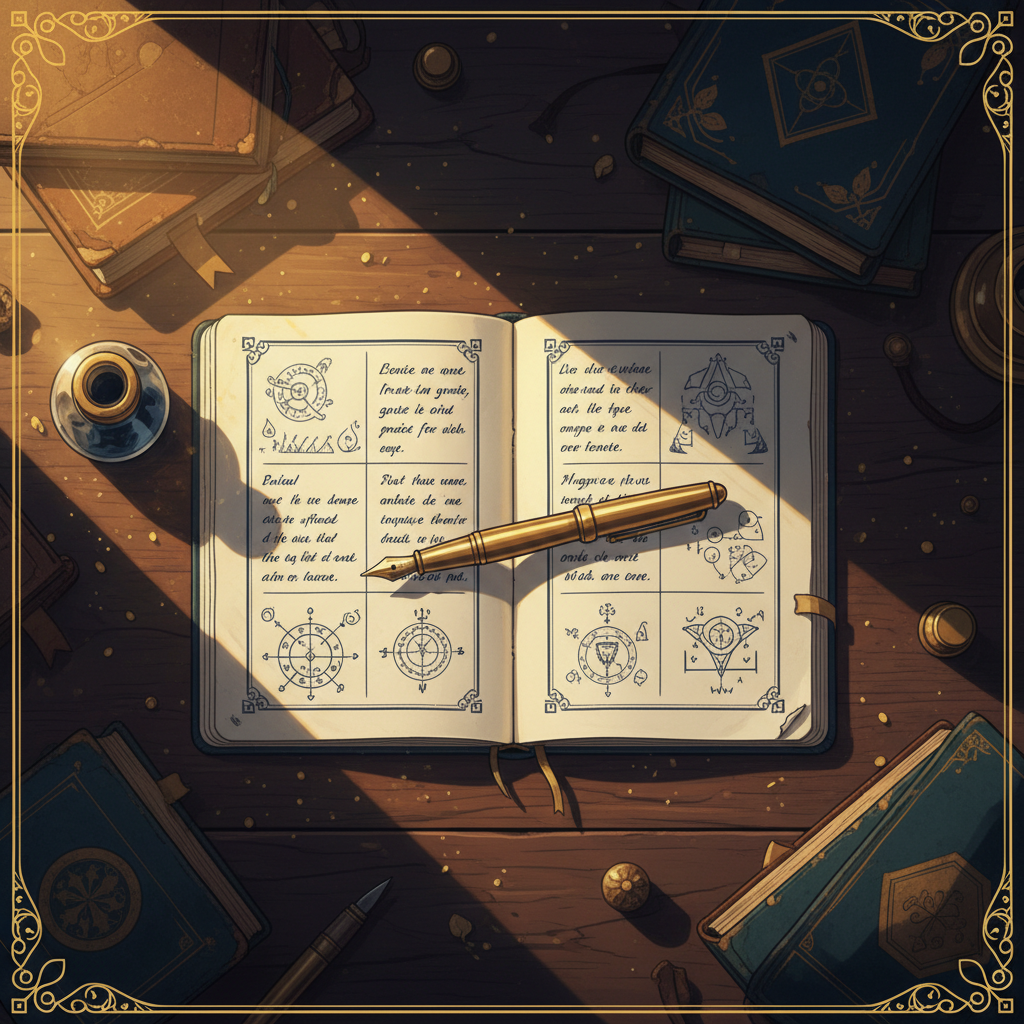
This week, when you encounter a spread where two cards seem to actively cancel or argue with each other, do not reshuffle. Take a notebook and draw a simple two-column table labeled 'Thesis' and 'Antithesis.' Place Card A in the left column and Card B in the right. Beneath each, write down three objective, concrete facts about what that card demands or describes, stripped of your personal emotional preference.
Once the facts are on paper, write a single unifying sentence at the bottom of the page that completes this exact prompt: *'These two forces exist in my situation at the same time because...'* For example: *'The Five of Pentacles and the Ten of Cups exist in my situation at the same time because I am experiencing financial anxiety despite being surrounded by deep personal support.'* By forcing your mind to articulate the connective bridge, you move out of cognitive dissonance and into actionable clarity. The contradiction ceases to be a flaw in the spread; it becomes the exact blueprint of your current reality.