Written by Destiny · Tarot · 20 November 2026 · 6 min read
The Person Across the Table: Reading the Queen of Swords in the Flesh
Court cards flatten into sterile archetypes when we treat them as symbols. In practice, the Queen of Swords is usually someone you already work with, argue with, or secretly fear disappointing.
Most beginners learn the court cards as though they were catalog entries for medieval furniture. We memorize lists of attributes—air of water, mature intellect, sharp communication, boundaries—and then stare blankly at the spread when the Queen of Swords lands in the position of immediate environment. Is she an abstract mental state? Is she an invitation to be more assertive? Almost always, the answer is simpler and considerably more uncomfortable: she is an actual human being standing in your kitchen, sitting across from you in a performance review, or texting you back with three words where you expected four paragraphs.
The sixteen court cards of the Rider–Waite–Smith deck are portraiture, not philosophy. Pamela Colman Smith drew them with gestures of weight, posture, and gaze because they represent social weather—the specific temperaments of the people whose gravity pulls on your daily decisions. To read the Queen of Swords accurately, you have to peel her off the cardstock and look for her in your actual life. Once you recognize her cadence, you will never mistake her for an abstract concept again.
The Geometry of Her Chair
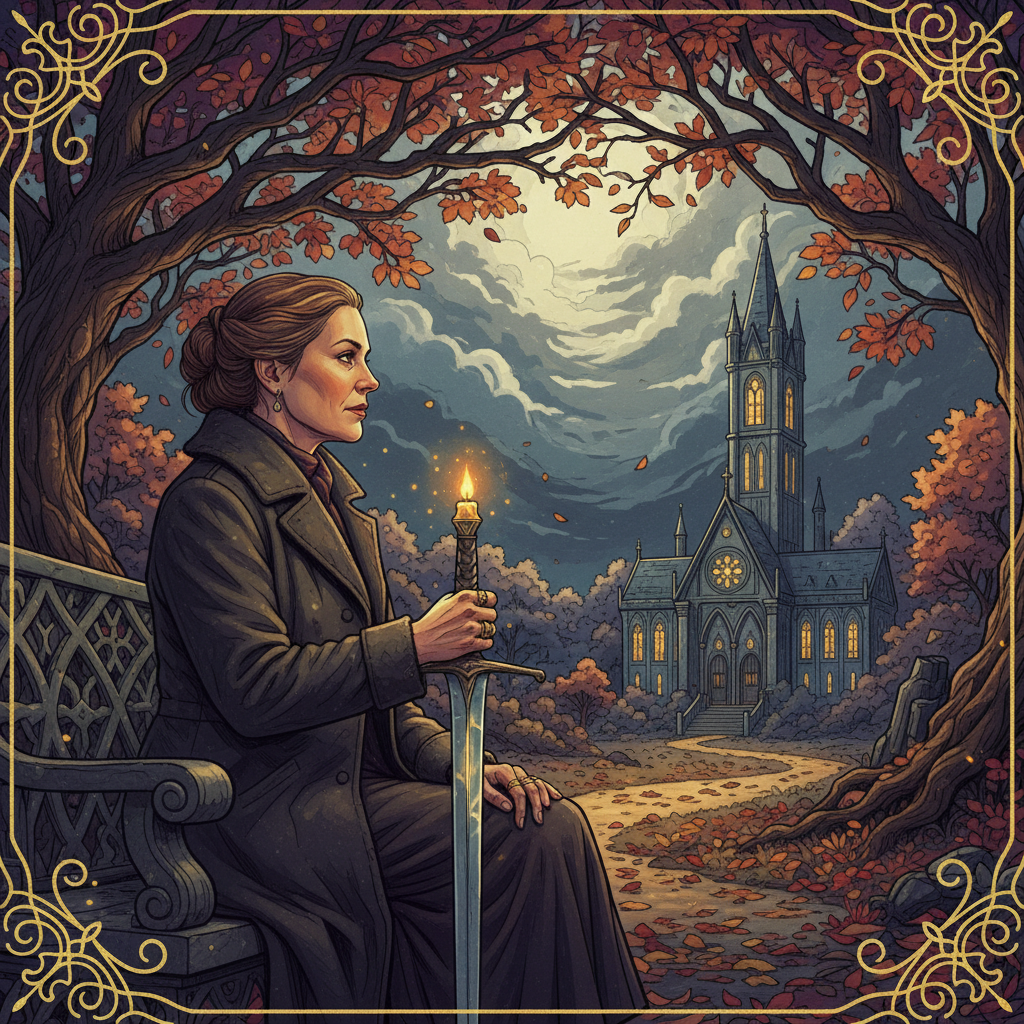
Look closely at the card Smith drew. Unlike the King of Swords, who faces forward with his blade tilted slightly, looking ready to deliver a verdict to a crowded room, the Queen sits in pure profile. She looks out past the edge of the frame into empty air. Her right hand holds a heavy double-edged broadsword straight upright, balanced cleanly on its pommel, while her left hand is raised open at waist height, gesturing outward. Cumulus clouds hang low and flat on the horizon, but above her head, the sky is scrubbed pale and cloudless.
This is not a woman who is bracing for an attack; this is a woman who has already survived one. The upright blade requires no frantic grip because she knows its center of gravity. Her raised left hand is not offering comfort or receiving a gift; it is testing the wind, measuring distance, establishing where your space ends and hers begins. The butterflies carved into her stone throne and her silver coronet represent the soul's capacity to transform through grief, while the child's cherub head beneath the armrest points quietly to innocence outgrown. She has traded illusion for visibility, and she does not regret the swap.
How to Spot Her in the Wild
In your life, the Queen of Swords is rarely cruel, but she is consistently economical. She is the senior colleague who reads your twenty-page proposal, strikes twelve pages of defensive throat-clearing with a red felt pen, and hands it back with the note: *Your actual argument starts on page thirteen. Run with that.* She is the physician who looks you directly in the eye, skips the comforting preambles, and tells you precisely what the pathology report means and what the next three weeks will require. She is the friend who listens to you lament a dead-end relationship for forty minutes before asking, without malice: *Do you want my sympathy, or do you want to talk about why you haven't packed your bags?*
People who rely on social lubricant find her terrifying. Our culture conditions us to expect women, in particular, to cushion every observation with qualifiers, soft laughter, and preemptive apologies. The Queen of Swords uses none of them. Her syntax is direct, her tone is level, and she does not adjust her facial expressions to make you feel comfortable with your own evasions. When she asks a question, she waits for the answer in complete silence. Most people become so undone by that silence that they rush to fill it with confessions.
The Trap of Trying to Warm Her Up
The most common mistake people make when dealing with a Queen of Swords in their circle is trying to manage her mood. If she is your manager, your mother, or your business partner, your first instinct when she presents you with an unvarnished assessment might be to appease her. You bring extra warmth; you over-explain your motives; you perform contrition or search for an emotional crack where you can insert a bid for reassurance. This is a tactical disaster.
She does not want your performance of guilt, and she does not want your flattery. What she wants is competence, clarity, and accountability. If you missed a deadline because your week fell apart, she will respect you if you say, plainly: *I miscalculated the scope, and it will be on your desk by Thursday at noon.* If you instead offer her a sprawling, tragic narrative about your stress levels and your intentions, she will listen with a face like winter water, mentally reducing your reliability rating by another ten percent. She views sentimentality as a form of intellectual dishonesty—an attempt to use feelings to obscure facts.
What It Means When She Backs You
Because her default setting is rigorous, people often assume the Queen of Swords is an adversary. In reality, having her in your corner is one of the greatest assets you can possess. Her loyalty is structural, not emotional. She will not flatter you when your work is sloppy, but if someone attacks you unjustly behind closed doors, she will dismantle their argument with documented dates, exact citations, and zero theatrical outrage.
Her praise, when it comes, is sparse enough to carry absolute value. When the Queen of Swords in your life looks over something you built and says, *That is solid,* you know it will hold weight in the real world. She does not give participation trophies. If she tells you that you are ready to take a risk, ask for the raise, or leave a bad situation, you can trust her calculation because she has already subtracted all the wishful thinking from the equation.
The Shadow She Casts
Every court card carries a cost, and her cost is insulation. When this archetype curdles into its shadow, the precision becomes preemptive armor. The shadow Queen of Swords has decided that since vulnerability once brought her unbearable grief, she will never again allow anyone close enough to touch her unarmed. She uses her intellect as an incinerator, burning through connections before they can complicate her life.
If you are reading for yourself and this card appears alongside cards of isolation—the Four of Swords, the Five of Cups, the Eight of Wands reversed—ask yourself whether the person you are dealing with has crossed this boundary. An injured Queen of Swords will mistake cynicism for realism. She will scoff at sincerity because she cannot afford to believe in it. When you encounter her in that state, arguing with her is useless; her armor has no joints. Your only sensible move is to maintain your own boundaries, refuse to engage in intellectual blood-sports, and let her carry her sword in her own lonely circle.
The Work for This Week
Sometime in the next seven days, you will find yourself in an interaction where you are tempted to fudge a boundary, soften a necessary 'no' with a rambling excuse, or seek reassurance from someone who has already made their position clear.
Find the person in your life who embodies this Queen. Before you write the email, attend the meeting, or answer the call, run your words through her filter. Strip out the apologies that are actually defenses. Delete the qualifiers. State what is true, state what you can do, and stop talking. Notice how much energy returns to you when you stop trying to convince people to like what you must plainly decide.